TOP-14 countries that have nuclear weapons and in what quantities
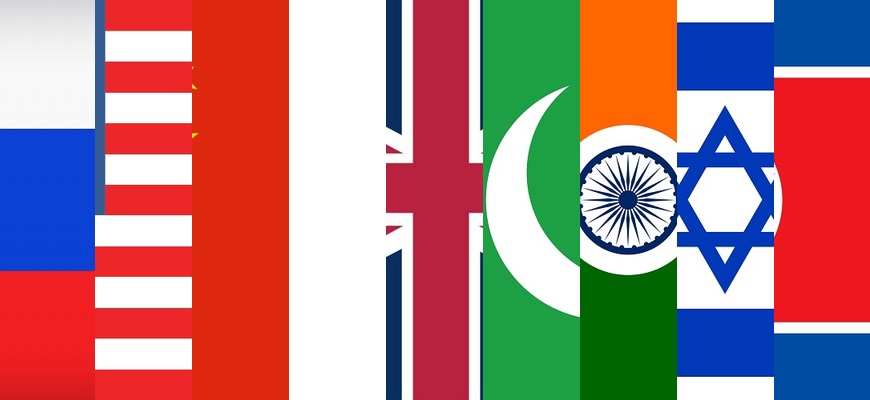
All states that have officially declared that they have been able to develop, produce, and test nuclear weapons become members of the "Nuclear Club. Of course, there is no such organization; the informal name is essentially a political science cliché.
Basic
Members of the "Club" are conditionally divided into "old" and "new". The former acquired this type of weaponry during the Second World War or soon after it, the latter - relatively recently.
Russia (former USSR)
- Total warheads: 5977 (according to other sources - 7000).
- Active: 1588.
The first success of the Soviets was the RDS-1 device (22 kilotons). The explosion was carried out on 29.08.1949 at the Semipalatinsk test site. Then the USSR was definitely able to "catch up and overtake America" by creating the Tsar Bomba (57 megatons).
The tests took place in 1961, on the archipelago of Novaya Zemlya. Until 1990, the country carried out more than 700 explosions, "along the way" developed technology for the production of thermonuclear and hydrogen bombs.
They were tested, in addition to the places already mentioned, at Kapustin Yar, Totskoye and Sary-Shagan test sites. Only Russia inherited the nuclear arsenal of the defunct Union.
Other republics where such weapons were located (Kazakhstan, Belarus, Ukraine) signed the Lisbon Protocol in 1992 and fulfilled their obligations not to prevent the export of munitions to Russia.
As Ukraine's first president Kravchuk noted, this decision was dictated by the lack of a technical base for timely maintenance of the remaining nuclear stockpiles - having such weapons is a great responsibility and expensive. The other republics probably had similar reasons.
USA
- Total warheads: 5428 (another view is 6800).
- Active: 1644.
They were the first to carry out a nuclear explosion. The Trinity bomb (20 kilotons) was detonated on 16.07.1945 on the territory of the USA (Alamogordo Desert Proving Ground, New Mexico).
The thermonuclear charge was activated on 01.11.1952, already outside the United States (Eniwetok Atoll in the Pacific Ocean). Subsequently, the "testing grounds" for very active tests were "Zone-51" in Nevada and Bikini Atoll.
The most powerful of the American charges Castle Bravo (15 megatons) did not reach the Soviet "Tsar Bomba". The U.S. is the only country that has experience in using weapons of this type in actual warfare. The bombs named "Little Boy" and "Fat Man" were dropped on Hiroshima and Nagasaki in Japan in August 1945.
China
- Total warheads: 350 (alternative opinion - 270).
- Active: unknown.
Became a nuclear power on 16.10.1964 by detonating the bomb "596" with a capacity of about 20 kilotons at the test site near Lake Lobnor on its own territory. Successful thermonuclear tests were also conducted there (17.07.1967).
The "test" explosions stopped only in 1996. In 2011, China announced that it would refuse in principle to launch or threaten to launch nuclear strikes against countries that do not possess similar weapons, but would retain the necessary minimum of nuclear weapons in its arsenal. The Chinese authorities are still silent on the issue of the quantitative expression of "sufficiency.
France
- Total warheads: 290 (possibly more - 300).
- Active: 280.
The first experience of more than two hundred French tests was the explosion of a 20-kiloton charge called "Blue Toucher" in the Algerian oasis of Reggane (13.02.1960).
They were then moved to the atolls of French Polynesia. Mururoa was particularly affected, where, among other things, a thermonuclear bomb was detonated on 24.08.1968.
The decision to stop the tests was made only in 1995. Prior to that, France had consistently refused to participate in any peace initiatives, not supporting, for example, the moratorium on nuclear testing in the 50s. The key treaty in this area was signed only in the early 90s.
UK
- Total warheads: 225 (there is another option - 215).
- Active: 120.
It has never practiced nuclear explosions on its own territory. The first successful tests were surface tests near the Monte Bello Islands (Australian waters). They took place on 03.10.1952, the bomb "Hurricane" had a power of 25 kilotons.
Weapons testing continued until 1991, mainly on Christmas Island (Kiribati). The "birth" of the British thermonuclear charge took place there (15.05.1957).
Pakistan
- Total warheads: 165 (according to other sources - 130-140).
- Active: 0 (presumably).
Attempts to create their own developments have been made in Pakistan since the mid-50s. They became especially active after India "joined the Club": the task of "catching up and overtaking the neighbor" was more urgent than ever, given the permanently hostile relations between the two countries.
However, despite significant financial injections, they had to wait for more than 20 years. Successful were the explosions of 28-30.05.1998 at the Ras Kokh range (Baluchistan province). The bombs were named "Chagai-1".
India
- Total warheads: 160 (possibly 120-130).
- Active: 0 (presumably).
The first success India preferred to keep silent without announcing its nuclear status after the explosion at the Pokhran test site (Rajasthan). It took place on 18.05.1974, the power of the "Smiling Buddha" charge was estimated at 20 kilotons.
Official recognition followed only after a series of three (according to other sources - five) explosions on 11-13.05.1998. Among the charges was a 32-kiloton thermonuclear one. Two days later India announced that there would be no more test explosions.
Israel
- Total warheads: 90 (according to other sources - 80, there are less realistic versions - from 150 to 400).
- Active: 0 (presumably).
Israel has never officially confirmed or denied the persistent rumors of having its own "non-peaceful atom. All contradictory comments on this issue can be summarized in a phrase of former prime minister, the legendary Golda Meir, who said that Israel does not have nuclear weapons, but will use them if necessary.
Israel is not a signatory to the Non-Proliferation Treaty. Probably, it should be considered a "member of the Club" since 1979, when the so-called "Vela Incident" took place, to which South Africa contributed (its nature and degree of importance are still debated). Very suspicious light flashes were recorded in the waters of the South Atlantic.
North Korea
- Total warheads: 20-43 (in general, the variation in sources is large - from 10 to 60).
- Active: 0 (presumably).
The DPRK authorities announced their outstanding success in this area in the summer of 2005. Officially, "joining the Club" was confirmed on 09.10.2006, after an underground explosion with a capacity of about a kiloton.
Then more powerful charges were detonated in 2009, 2013, 2016, 2017. The relevant developments were started back in the 50's, at the initiative of Kim Il Sung. All activities are limited to the area of the Kilchu test site (Hamgen-Pukto).
To date, the DPRK has managed to create a thermonuclear charge and "stuffing" for intercontinental ballistic missiles. The next tests are "announced" in 2023.
Which countries still have nuclear weapons (from the U.S.)
On the territory of some European countries there are American nuclear bombs (various modifications of the B61), transferred to them for "storage". There is also a point of view, which has not yet been convincingly refuted: according to it, Japan and South Korea are also among the "keepers".
Turkey
How many: 50.
The most "richly endowed" of all countries. Their storage site, Incirlik Air Base, is simultaneously home to the 39th Wing of the U.S. Air Force, the 10th Wing and the 2nd Air Force Command of the Turkish Air Force.
But in 2016, after a failed military takeover, President Erdogan banned air traffic to the base, greatly angering NATO allies. Now their relations are also far from ideal.
The US is reacting very negatively to Turkey's purchase of Russian arms. There is an opinion that the conflict will end with the "relocation" of warheads to a more "loyal" country, such as Romania or Greece.
Italy
How many: 35+40.
It has not one but two American airbases on its territory. The first is Aviano, relatively close to Udine. It has been operated by the US since the mid 50's. Among other things, there are 12 "sarcophagi" for nuclear bombs.
The second is Gedi-Torre, very close to Brescia. The 704th Ordnance Maintenance Squadron (USA) is responsible for the proper storage and maintenance of the charges. It is "neighbored" by an Italian squadron of "compatible" Tornado IDS fighters.
Belgium
How many: 20.
The chosen location is the Belgian Air Force's Klein-Broegel Air Base near Brussels, where NATO headquarters is known to be located. On its territory "neighbors" local air squadron and the 701st Ammunition Maintenance Squadron of the U.S. Air Force.
Of all the "guardian" countries, the presence of bombs on their territory causes the most serious manifestations of public discontent in Belgium. However, even the theoretical possibility of their removal has never been discussed.
Germany
How many: 20.
The warheads, previously stored at Ramstein Air Base, were moved to Büchel relatively recently, in 2007. The latter, as the headquarters of the U.S. Air Force in Europe, the most important logistical hub and "transfer point" for personnel, has always attracted too much attention.
Büchel became the location of the 702nd Squadron of the U.S. Air Force AND the 33rd Tactical Wing of the German Luftwaffe. Apart from it, the German Air Force has no units with Tornado IDS fighter-bombers or others capable of carrying nuclear weapons.
Netherlands
How many: 20.
Until recently, the presence of bombs at the Dutch Volkel airbase was hushed up or outright denied by the local government. Official confirmation came only in 2013.
"Care" of the warheads is entrusted to the 703rd Munitions Maintenance Squadron of the US Air Force. Responsibility for their use in case of conflict will fall on the 312th and 313th squadrons of the Dutch Air Force, flying American F-16s. Their pilots, by the way, often practice training flights with the corresponding mockups.
In doubt
"Questionable" nuclear status of a certain state, more often than not, is a political manipulation. Such accusations are in most cases unsubstantiated and unsubstantiated (and if evidence is presented, it is very doubtful). Nevertheless, they become an excuse for certain actions on the part of the accusers and the countries supporting them.
Iran
Accusations of having its own nuclear program, which is not aimed at creating independent energy, have been made against Iran for several decades.
The state does not deny the existence of research, but firmly insists that it enriches uranium exclusively for peaceful purposes (by 2010, local specialists had mastered the full cycle) and refuses to develop weapons for ideological reasons.
Iran's nuclear program has been under IAEA control since 2015. At the moment, the state has denounced all agreements in this area, abandoning the restrictions imposed on it.
The occasion was the US air strike on the international airport in Baghdad, as a result of which Qassem Suleimani (Lieutenant General, commander of the Al-Quds unit within the IRGC) was killed.
Iraq
The most striking example of what the consequences of deliberate disinformation can be in the field of nuclear weapons development. Since the mid-1970s, the United States, the United Kingdom, and Israel have made accusations against Iraq.
The latter even felt it had the right to launch a missile "preemptive strike" with its own aircraft against what the government and army leadership considered to be a center where covert development was taking place.
In 2003, the unproven possession of such weapons was one of the reasons for the invasion of Iraq and the overthrow of Saddam Hussein's regime. Subsequently, the information on which the decision to launch the operation was based was officially recognized as false.
Myanmar
Practically repeats the path of Iran. The state signed the Non-Proliferation Treaty in 1992 and the Bangkok Treaty on a Nuclear Free Zone in Southeast Asia in 1995. However, its programs in the relevant sphere are recognized as "unclear" and "dubious" at best.
The lack of control over the activities of local specialists by the IAEA and the UN also adds fuel to the fire.
In addition, there are obvious ties with China, active cooperation with Rosatom, and the fact that Russia, as a permanent member of the UN Security Council, has been purposefully blocking any resolutions "hostile" to Myanmar for several years in a row, including proposals for further sanctions.
Are there other countries that may soon fully acquire nuclear weapons?
In 1963, when the number of members of the Nuclear Club was limited to four, there was an analytical report in the US that predicted that the number would rise to 15-25 within the next decade.
There were also more dire predictions, predicting the emergence of some 50 nuclear-armed states. Fortunately, they did not come true. The strict "nonproliferation regime" and the relevant Treaty helped. However, in different years there have been reports of the existence of "non-peaceful" nuclear programs or relevant developments:
- Algeria;
- Egypt;
- Libya;
- Saudi Arabia;
- Argentina;
- Brazil;
- Mexico;
- Taiwan;
- South Korea;
- Spain;
- Sweden;
- Romania.
At present, several countries have the necessary scientific and material base in the field of nuclear energy, including reactors "for research only" and production facilities.
With the requested funding and the political will to do so, they may well soon join the Club, which its current members are trying hard to keep closed. The list includes:
- Australia;
- Japan;
- Argentina;
- Brazil;
- Spain.
As well as those that already have nuclear weapons from the NATO alliance:
- Germany;
- Netherlands;
- Belgium;
- Italy.
The example of South Africa is unique. The state (most likely, with the assistance of Israel) created its own samples and even conducted a series of tests at the turn of the 70s-80s of the last century. However, it soon voluntarily abandoned it, destroying all prototypes and technical documentation.