Camouflage Ghillie suits - history of origin, types, features and differences

Thanks to cinematography and video games, the image of a modern sniper or hunter is closely associated with a specific attribute - a camouflage suit. And strangely enough, this baggy figure with a sniper rifle looks cool. Let's understand how camouflage suit appeared, what kinds there are, as well as their features.
Prerequisites of appearance
The development and spread of camouflage suit was influenced by various factors and events, which can be described as follows:
Scottish origins
Ghillie suits began to be used by Scottish gamekeepers who needed effective camouflage for catching illegal poachers, hunting and fishing expeditions.

However, they were not used on a large scale, due to the low accuracy of small arms. Before the advent of accurate threaded rifles, battles were fought at close ranges and usually in line formations, and the uniforms were brightly colored, so the advantages of camouflage were negated.

During the Second Anglo-Boer War (1899-1902), the Lovat Scouts in the British Army were among the first to adopt these suits, realizing their potential in warfare. They were skilled marksmen, renowned for their skills in the field and in pursuit of the enemy.

In terms of time - it is just the beginning of the XX century, when the weapon already allowed aiming fire at long distances, which eliminated the above-described disadvantage.
Names
They were named based on Scottish mythology, in which there are mythological forest creatures Ghillie Doo, dressed in clothes made of fallen leaves and moss. Hence the English-language name of the costume, Ghillie suit, "Ghillie suit".
In the Australian army camouflage suits are called "Jovis", after the mythical humanoid creature Jovi, similar to Yeti and Bigfoot. In Russia, such costumes are called "Kikimora" and "Leshy".
The widespread use of camouflage and the advent and modernization of telescopic sights during World Wars I and II led to the accelerated development and specialization of camouflage suits, especially for sniper units.
Appearance
Bundles of natural jute or synthetic yarns, as well as scraps of fabric in various shapes tied to a net or sewn directly onto the costume, are used to create clothing resembling thick foliage. Some users even use real leaves or mud for more authenticity.
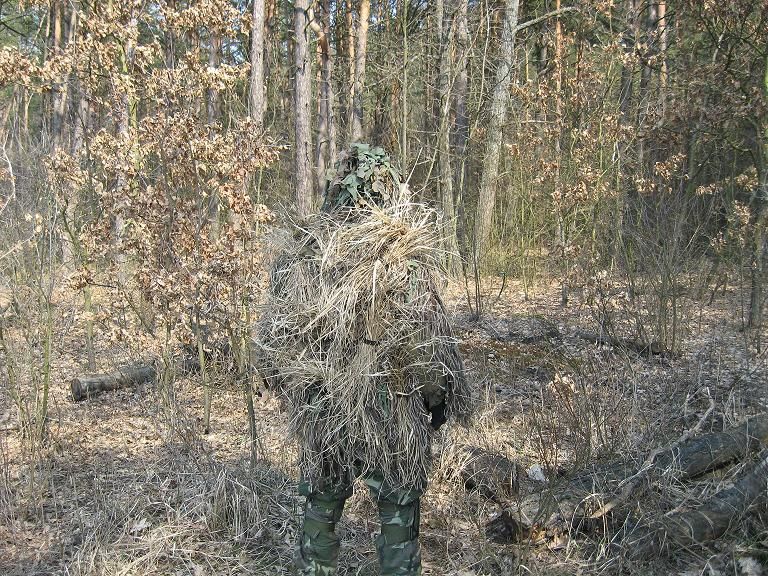
A prerequisite for creating a quality appearance of suits is a careful study of natural conditions, selection of suitable materials and preliminary preparation, "naturalization".
This involves special contamination of the costume to match the environment - dragging it through a few muddy puddles, wetting it with glue and throwing on leaves and debris. This makes the fabric visually more similar to the environment, so that even from a few meters the suit performs its function.
It is also important to think about the specifics of the terrain in which the suit will be used - depending on the vegetation, weather and time of year, the visual part may differ significantly.

Form Factors
There are different types of camouflage suits, each designed for use in different environments and with different uniforms.
A suit can be based on a regular uniform in a larger size, in which slits are made to allow access to the inner layer of clothing. Camouflage nets can be used. Now it is often a special cut for specific purposes.
Poncho suits have become popular, which give full access to the interior, can easily be used as a cape, a temporary shelter.

Many modern suits are designed with comfort in mind, including features such as ventilation and adjustable fit.
Who uses
As is not hard to guess from the history of appearance, the military, especially sniper and reconnaissance units, largely use camouflage suits for concealment during missions. Law enforcement may also use them for stealth during covert operations.
The use of ghillie camouflage suits has moved beyond military and professional use to civilian use. For example, hunters often wear ghillie suits to approach game undetected.
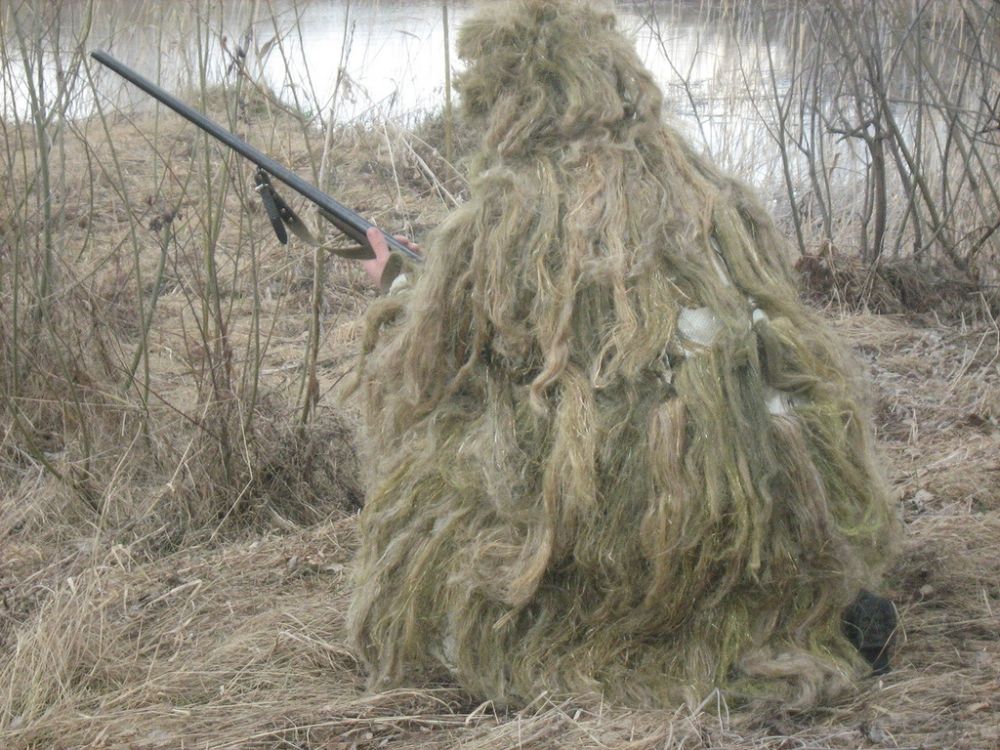
Wildlife photographers use this clothing to capture animals without disturbing their natural behavior.

Paintball and airsoft enthusiasts often use camouflage suits to make the game more realistic and strategic.
The various uses of ghillie camouflage suits demonstrate their versatility and effectiveness in both professional and recreational settings.
In recent years, ghillie suits have become available in various retail stores and online venues, making them accessible to the general public. In addition, the portrayal of camouflage suits in movies, television, and other media has popularized their appearance and led to broader cultural interest.